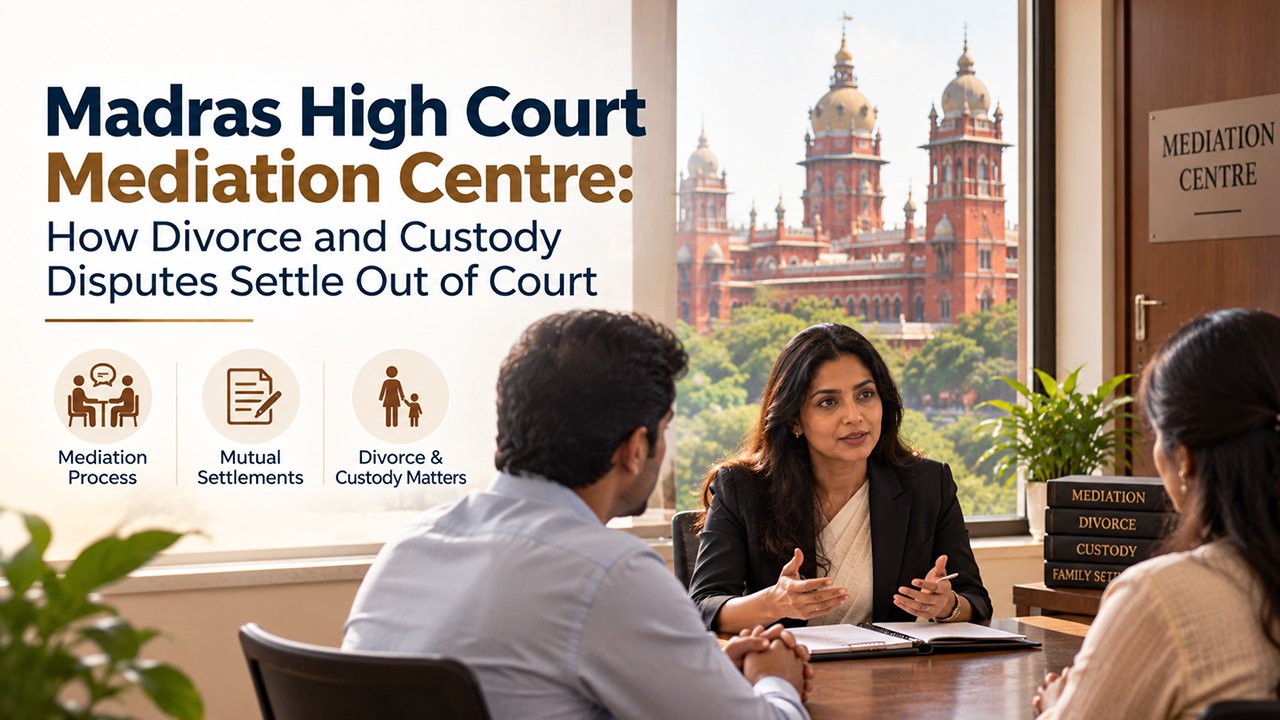
The money is tight, tempers are high, and your first hearing ends with a referral to the madras high court mediation centre. What now, and how does this help you settle faster without giving up your rights?
If your dispute sits in Chennai or elsewhere in Tamil Nadu or Andhra Pradesh, mediation is often the shortest path to a workable parenting plan or a clean exit. This guide explains how the mediation centre chennai process fits alongside your case, what papers the mediator will ask for, and the timelines you should plan for.
What The Madras High Court Mediation Centre Actually Does
The madras high court mediation centre is a court-annexed forum where trained mediators help spouses and parents negotiate settlement terms. Judges refer pending family matters so parties can talk in a confidential space and try solutions that a decree alone may not deliver. Readers weighing a related question may also find our piece on Annulment of Marriage vs Divorce in Chennai: Grounds, Procedure, useful.
Family disputes referred include mutual consent divorce paperwork, contested divorce cases that may shift towards consent, interim maintenance or access schedules, and pure custody petitions. The madras high court mediation and conciliation centre also receives referrals from subordinate courts across Chennai and nearby districts when a High Court case is connected.
Referral And Jurisdiction: Chennai And South India
In practice, referrals come from the Chennai Family Court or a Madras High Court bench using Family Courts Act s.9 and CPC s.89. If your case is in the Family Court campus, the judge may send you to the in-house facility for family court mediation chennai, or to the High Court centre if appropriate.
Jurisdiction is local. For divorce under the Hindu Marriage Act or Special Marriage Act, venue lies where the marriage was solemnised, where the couple last lived together, or where the wife presently resides within Tamil Nadu or Andhra Pradesh. Referrals work the same way in Coimbatore, Madurai, Tiruchirappalli, and at the Andhra Pradesh High Court in Amaravati.
Legal Provisions That Apply
Family Courts Act, 1984 — s.9: The court must attempt settlement. This is the statutory push that sends your matter to mediation before full trial.
Family Courts Act, 1984 — s.7: Confirms the Family Court’s power over matrimonial and custody disputes, and to pass consent orders when you settle.
Code of Civil Procedure, 1908 — s.89 and Order X Rules 1A–1C: Lets courts refer parties to mediation and tells the court what to do with the settlement when you return.
Hindu Marriage Act, 1955 — s.13B: Provides mutual consent divorce with a statutory gap between the two motions. Mediation often produces the consent terms used here.
Special Marriage Act, 1954 — s.28: Parallel provision for couples married under SMA who choose to settle and seek a consent decree.
Hindu Marriage Act, 1955 — s.26; Guardians and Wards Act, 1890 — s.7 and s.17: These govern custody and visitation. The child’s welfare is the first concern, and mediated parenting plans are judged against that standard.
BNSS, 2023 — s.144: Summary maintenance. Figures for interim and final maintenance are frequently negotiated in mediation and then presented for orders.
Two Supreme Court guides shape timelines: Amardeep Singh v. Harveen Kaur (2017) held the six-month waiting period under s.13B(2) is directory and may be waived, and Shilpa Sailesh v. Varun Sreenivasan (2023) confirmed the Supreme Court’s power to dissolve a marriage on irretrievable breakdown under Article 142. For custody, Gaurav Nagpal v. Sumedha Nagpal (2009) reiterates that a child’s welfare outweighs either parent’s legal right.
Step-By-Step: The Mediation Process In Chennai
First, the court passes a short referral order. The Mediation Centre fixes an initial session, usually within a few weeks. Both sides sign confidentiality terms. Lawyers may attend or step out for private caucus discussions, depending on what helps progress.
Second, the mediator identifies issues: alimony, property, schedules for the children, school expenses, or withdrawal of parallel cases. In many divorce mediation chennai matters, interim access is fixed early so the conflict cools while you discuss the long-term plan.
Divorce Terms Typically Settled
Separations and divorce settlements often cover four heads: the legal route (mutual consent or withdrawal of allegations), money (lump-sum or monthly support), property transfers, and timelines for filings. Where allegations like adultery or desertion are pleaded, parties sometimes park them and move to consent; see also Adultery as a Ground for Divorce in Chennai: What and Desertion as a Ground for Divorce in Chennai: How.
Custody And Parenting Plans
For custody, the mediator will ask for school calendars, travel time from homes to school, and the child’s routine. Parenting plans that work in Chennai usually map term-time and holidays clearly, with handover points and video calls. Consent terms are taken to court under HMA s.26 or the Guardians and Wards Act for an order.
For NRI Families And Virtual Mediation
NRIs with families in Chennai, Tiruchirappalli, Coimbatore, or Hyderabad can attend by video conference. If a spouse is abroad, plan notarised or apostilled identification and authority documents for signing mediated terms, and factor courier time so the court can accept originals when converting the settlement into orders.
Timelines, Sessions, And Costs
Mediation at court-annexed centres in Chennai typically concludes within two to three months, with three to five sessions of one to two hours each. If you reach settlement on divorce, the next step is filing the consent petition; the statutory six-month interval under HMA s.13B or SMA s.28 applies unless the court waives it on facts.
There is usually no fee payable to the Mediation Centre. You bear your own advocate’s fee and incidental expenses like photocopying or certified copies. Parenting arrangements can be placed before the court for interim orders even while mediation continues, which keeps contact predictable and reduces conflict.
Documents The Mediator And Court Will Expect
Come prepared. Mediators cannot decide without facts, and missing papers stall talks. Keep originals safe and bring copies:
- Marriage certificate, children’s birth certificates, and recent photographs.
- Proof of residence and identity (Aadhaar, passport), especially for NRIs participating online.
- Income and expense proof: salary slips, bank statements, IT returns; the Rajnesh v. Neha (2020) affidavit on assets and liabilities is a practical template.
- List of stridhan and household effects to be returned, with a simple inventory.
- School fee schedules and calendars, and any special needs documentation for the child.
- Property documents if a transfer or settlement is proposed, and bank details for payments.
Most family law services will also prepare a draft parenting plan and a term sheet. These save time in the room and help a mediator focus on gaps rather than retyping what you already agree.
Common Roadblocks And How To Avoid Them
Three patterns derail settlements in Chennai: coming without decision-makers, insisting on perfect outcomes, and ignoring practical logistics like commute times or exam calendars. Bring whoever must sign. Trade positions for interests. Test every clause against your week-by-week routine.
Power imbalance and safety concerns need handling. If there is a history of abuse, ask for shuttle mediation and clear ground rules. Interim protection or maintenance can be sought in parallel so you are not bargaining under pressure. When in doubt, speak to a family lawyer before agreeing to terms that are hard to change later.
If There Is Domestic Violence Or A Criminal Case
Mediation does not wipe criminal complaints. Allegations of cruelty under BNS s.85 (formerly IPC s.498A) or dowry issues will proceed in their forum. What you can still do is settle civil aspects such as parenting, residence, and support, and place those terms before the court hearing the criminal matter for appropriate orders. Under the Protection of Women from Domestic Violence Act, 2005, interim custody orders under s.21 may be needed first to stabilise access.
Referral And Venue Tips For South India
In Tamil Nadu and Andhra Pradesh, referral practice is consistent: the Family Court explores settlement at the first effective hearing and may order mediation immediately. If you file a custody petition in Vijayawada or Visakhapatnam, you will likely be sent to the District ADR Centre, with the option to move to the madras high court mediation centre if your connected appeal is pending there.
If your marriage was under the Special Marriage Act and you live in different states, CPC s.25 permits transfer between states when justified. An experienced family lawyer in Chennai will weigh convenience, witnesses, and where the child lives before seeking transfer or consent venue.
Conclusion
Mediation works when you prepare, document your ask, and stay open to workable trade-offs. If your family case is headed to the madras high court mediation centre, treat it as your main hearing, not a detour. If you need structured help beyond these family law guides, Advocate Manjula’s team approach in Chennai is practical and steady. If you are unsure about the next step, speak to a family lawyer.
Frequently Asked Questions
Is mediation at the Madras High Court Mediation Centre compulsory if the judge refers my case?
Once the Family Court or High Court refers your matter under CPC s.89 or Family Courts Act s.9, you are expected to attend. The process is voluntary on outcomes, not attendance. You can pause or end it if it is not helping, but skipping sessions without cause risks adverse remarks on conduct.
How long does divorce or custody mediation usually take in Chennai?
Most court-annexed mediations in Chennai complete within two to three months, often across three to five sessions. If you settle on mutual consent divorce terms, remember the statutory six-month interval under HMA s.13B unless waived. Parenting plans, if agreed, can be recorded as consent orders much sooner.
What does it cost to use the court-annexed Mediation Centre in Chennai?
There is typically no mediator’s fee at the court-annexed centre. You pay your own advocate’s fee and document costs. If experts are engaged, like a child counsellor, those expenses are separate. Settlements involving property transfer may attract stamp duty and registration charges outside the mediation.
Can NRIs participate in mediation if one spouse is abroad?
Yes. The Madras High Court Mediation Centre and Chennai Family Court frequently allow video-conference participation. You will need notarised or apostilled identification and authority documents when signing, and original papers later for court filing. Plan for time zone-friendly sessions and courier timelines for signed terms.
If we settle, will the court immediately grant a divorce decree?
If a contested case is pending, the court usually asks you to file a fresh mutual consent petition under the relevant law (HMA s.13B or SMA s.28). The settlement terms are annexed. The decree follows the statutory process, including the interval between motions, unless the court grants a waiver as per precedent.
What happens if mediation fails? Will the judge know what we offered?
If the case is not settled, the mediator sends back a simple “not settled” report. Offers and discussions remain confidential and are not shared with the trial judge. The case returns to the Family Court or High Court for the next procedural step, such as framing issues or hearing interim applications.